words from guatemala
The plane landed smoothly and promptly at 5:05am, quelling some of the anxiety that had been budding in me for many months as I awaited this moment: the beginning of this six month adventure around the world. I held my things tightly as I’m accustomed to, in general, especially now, as I braced myself for a new place, still carrying with me the unwanted weight of a comment from a TSA agent in LA. Head down, routinely checking our passports, he asked where we were headed. Upon receiving our reply, without skipping a beat, he said plainly, “Don’t die.” “Sorry, what was that?” I asked, quite sure that I had misheard him. “Don’t die,” he said. “You’re not from there, they don’t care about you.” I wish I had said something more profound, to challenge such an ignorant and unwelcome remark, but all I said was, “Ah, don’t say that. We’ll be fine.” At the time it gave us a pit in our stomachs, raising the stakes of this trip to the highest degree. In retrospect I find this interaction less of a foreboding warning and more of a distinct example of the misconceptions and negative perceptions held (specifically in America) about the world (specifically non-white/western).,and/or some innate hyper vigilance to fear the other and to mark all strangers as threats. But what a limiting view! I can acknowledge the complexity and nuance within difference, and the strange intermingling of privilege and discomfort that comes with traveling but I hope to enter this journey (life, really) with a sense of humility, curiosity, and reverence. These are not uncommon fears or desires, but a good reminder to illuminate ourselves with openness, understanding, and compassion for people we do not know, places we have not been, and things unfamiliar to us. I knew very little of Guatemala before. And I can see now my own lack of information and how that shaped my understanding, or lack thereof. How exciting to say now how much I have learned about the beauty, resistance, and strength of the people and history of Guatemala.
Most airports, especially international ones, intimidate and overwhelm me. Not knowing where you’re going, not being able to speak the language, and carrying a little microcosm of your life in a suitcase alongside you. I wiped the sleep from my eyes, willing myself to be alert for whatever awaited us. Much to my relief, we stepped off the plane into a calm, quiet, and small airport, surrounded by a lush and peaceful green. The early morning sun was still hiding behind the hills. Within 10 minutes of getting off the plane, we were on our way into the blue haze of Guatemala City. The far away sun rose as we waited to board the Xelabus. Stella placed her hand calmly on my rapidly bouncing knee. I get so buzzy on travel days, the liminality making me feel deeply unrooted. I readjusted, pressing my thighs more firmly into the seat. A massive old charter bus pulled in and to a stop, releasing a puff of exhaust as exhale. We shared the ride with about 6 other people, and soon after we departed for Xela, the sounds of snores filled the warm darkness. The curtains were drawn across every window and the reclining seats lay almost vertical. The bus was hypnotic, swaying like a giant cradle. It reminded me of the Nightbus from Harry Potter. An alarming exterior speed juxtaposed with a sleepy interior, our bags and bodies rocking back and forth as we careened around the mountain passes. I couldn’t help but laugh and say a quick prayer for safety before drifting to sleep. Hours must have passed, but very suddenly it seemed, we had arrived. Everyone was awake, shuffling down the narrow aisle towards the exit. We traversed on foot to a coffee shop near our airbnb to wait for our check in. The bus stop to the coffee shop was only a mile’s distance. The apparent shortness of the walk and vulnerability of being somewhere unfamiliar, prevented me from stopping to take off my sweatshirt or readjust my awkward, heavy things. We clunked along for what felt like an hour (but was really only 18 minutes), sweating determinedly, over cobblestone roads and hilly sidewalks. The coffee shop doors were wide open to embrace us as we huffed into our seats with great relief.
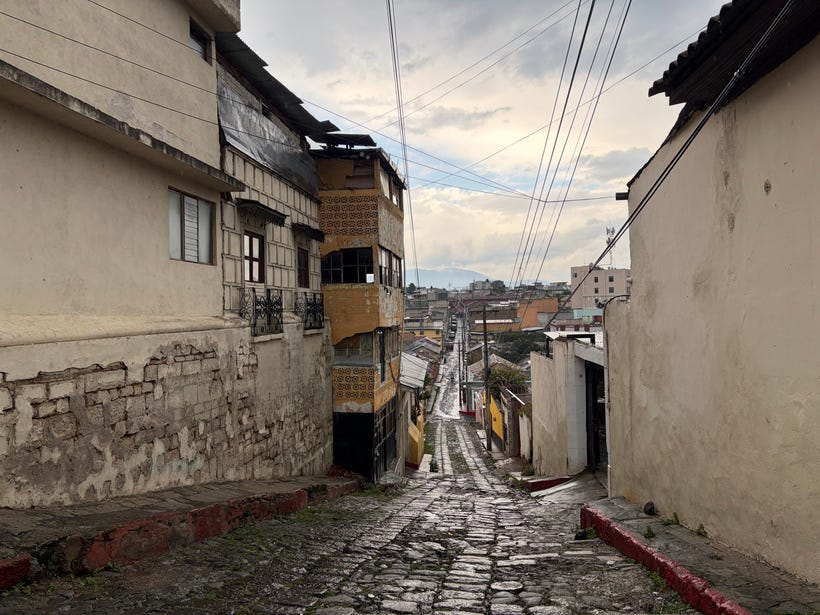
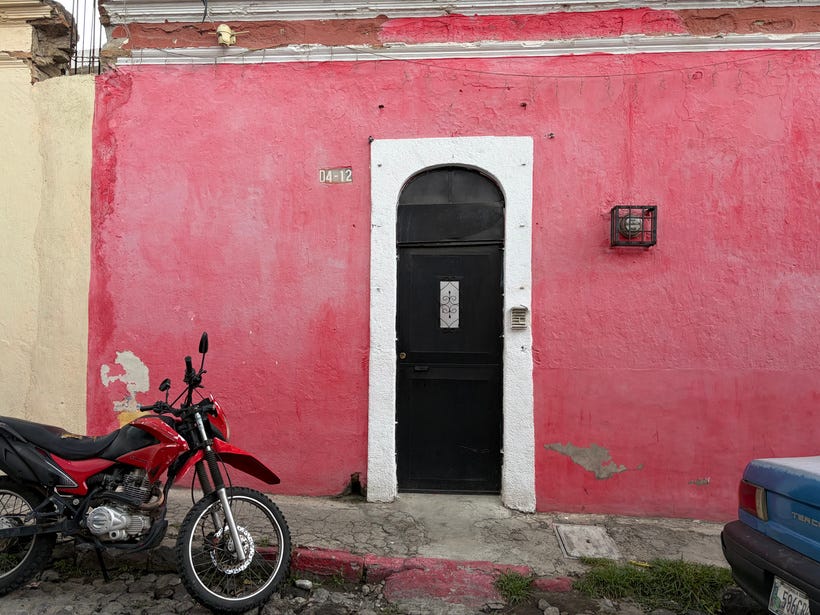
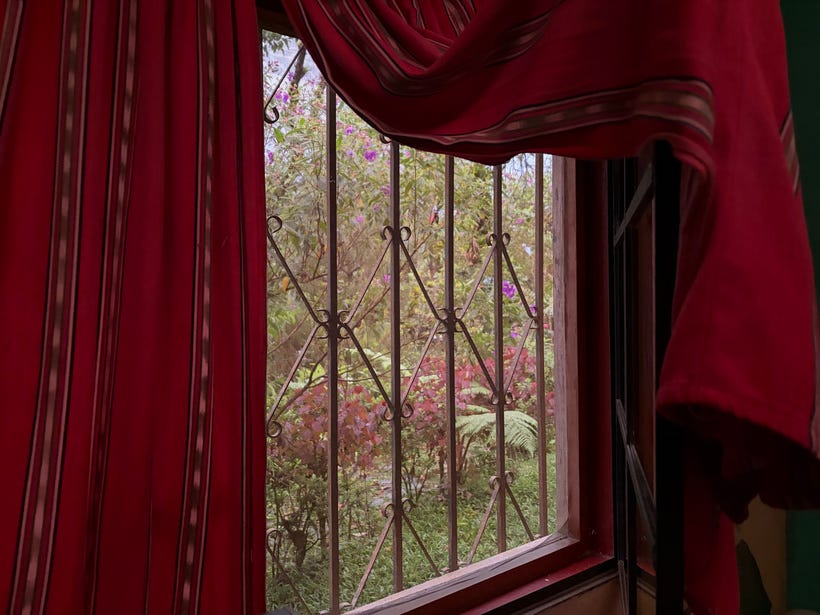
The experience of being in the backseat of a car, looking out the window, taking in thousands of different snapshots in succession. Visiting a new place feels like that to me. Passing too quickly for true depth but gathering a collection of pictures to comprehend a greater whole. The buildings in Xela are straightforward, colorful. Wrought iron protects most every window with practical but beautiful embellishments. The streets are narrow and winding, everything connected together like snaking blocks of stone. The town feels low to the ground, the sky and mountains creating a kind of backdrop above the uniform height of the buildings rounding themselves between valleys and hills. Marimba, the country’s national instrument, overflows from cars and stores and houses, twinkling its woody tune. Deep baritone voices bellow over acoustic guitar strings. Motorbikes out compete the cars for dominance on the road. Many women are dressed in varied handwoven colorful textiles, traje típico — traditional Indigenous clothing. Tiendas display snacks, fruit, toiletries, and trinkets. Murals of the national bird, also the name of the national currency, Queztals, adorn walls alongside flowers and words and chipping paint, creating a beautiful texture on every facade. Dogs sleep in doorways, wander alone or in packs. Grass pokes itself through the many mosaics of rocks lining the streets and sidewalks. Guatemala has a complicated feeling of being quite simple in many ways of life, as a result of a very storied and oppressive past.
Grace knocked on our door a few days after we had arrived, carrying a bulging backpack and a wide smile. At this point I didn’t know Grace very well, only by proxy through her long friendship with Stella. A few game nights, drinks out, an occasional swim at Echo Park Pool, but I wouldn’t say we were close. She is a very calm person. Easy to be around, quick to laugh, kind, accepting, thoughtful. By the end of the trip I felt so close to her. Surprised by my sadness in leaving her but delighted to have had this experience with someone I like so much. It doesn’t surprise me, Stella has consistently solid people in her life, something I respect and value in her. We welcomed Grace into the small studio airbnb we were staying in during our time in Xela. She would be staying at a hostel just around the corner. It became routine for us to eat dinner in the apartment together while we worked on our homework. Dinner was usually a sad sort of combination of things. Ramen, oatmeal, microwave nachos, a bowl of refried beans, maybe some Oreos, Pringle’s, pasta with a can of tomato paste from the tienda. I don’t know why it was so hard to cook ourselves a proper dinner for that week but we ate like college kids and sat tightly together on the couch watching TV every night until it was time to walk Grace home. I was most surprised to find the dogs to be my greatest anxiety, especially at night when they become more territorial. People in town know to avoid them, as they’ve experienced the danger of an animal in survival mode. We were taught to wield an imaginary rock, and to wind up our arm in a position to strike or to throw if a dog approached us threateningly. That first night we were scared to be out too late. Everything we had read offered vague but unanimous advice to not walk around after dark. We donned hats, hoods, and heavy jackets to hide our femininity or foreignness, from humans or dogs at that point we weren’t sure. Around 6:35pm we scurried out the door, around the corner, fully illuminated by street lights, passed no one, dropped Grace off, and returned promptly to our airbnb by 6:37pm. We laughed at ourselves. Each night our curfew got a little later as our comfort and knowledge of Xela grew.
༄
The first day at school felt just like I remember all my previous first days of school feeling like. Taking care to select my favorite outfit and prepare my bag of things. We arrived at Proyecto Lingustico Quetzalteco (PLQ) at 8am along with about 18 other students. Some were returning from last week and some, like us, were here for their first week. We gathered together in the multipurpose room, as I came to know it throughout the week. This is where we would later have a presentation from a community member on the latest political election, a conversation with Amaro, an ex-guerilla fighter and long time friend of the school, and a salsa dancing class. But on Monday, the room was for orientation. Brandon, PLQ’s administrator for new students, welcomed us and proceeded to give a detailed explanation of the history not only of the school but of Guatemala as whole over the last 500 years. From my notes, my conversations with teachers and hosts, and from the help of PLQ’s website, I will distill a bit of the history I learned. I’m going to try to write in a way that feels digestible and succinct for the sake of time and readability but I encourage you to check out PLQ’s website here for more information as well as two documentaries we watched during our time at the schools that helped provide a more detailed account of Guatemala’s history. Voice of a Mountain and When the Mountains Tremble tell stories from inside the internal arms conflict and reflections thereafter.
Proyecto Lingustico Quetzalteco was founded in 1988 by a group of teachers and activists, spurred to action by the government-led kidnapping and killing of two Guatemalan student activists, René Leiva Cayax and Danilo Alvarado, who were openly petitioning for change. This was a time of intense violence within the country, the height of brutality in the internal arms conflict, a war that lasted 36 years, from 1990–1996. “The founding members of PLQ had the goal of establishing a school that could effectively teach non-native speakers how to read, write and speak the Spanish language while providing support for organizations working to improve the human rights situation in Guatemala. In addition, the collective and staff of PLQ dedicated themselves to educating their language students, who came from all over the world, about the political situation in their country.”
PLQ provides comprehensive education about Guatemala’s social and political history through an array of educators and activists. We heard stories from ex-guerrilla fighters, political activists, and healthcare workers. We played soccer, visited a coffee finca, a natural sauna, and a volcano. Local guides led our expeditions, explaining the history of each place and the projects that exist in Guatemala that are fighting for justice, health, equity, and peace in their communities. The school has two branches, PLQ (the city school) and Escuela de la Montaña (EM, the mountain school). Both are NGOs owned by a collective of teachers that work extensively to provide not only education to their students but also to redistribute resources to the community. If you have any interest or questions about the school please lmk I would love to talk more about it. It was such an incredible experience! Or if you want to monetarily support the school and their projects, you can donate to PLQ or EM on their websites.
Now for the historical context!
*If you need to skip over this I would understand but it’s interesting and important context and I kind of can’t believe I knew none of this before*
༄
Spain colonized Guatemala in 1524. Before this, there was a rich tapestry of Mayan culture in the Mesoamerican period called the Classical and Post-Classical eras, marked by incredible feats of architecture, agriculture, math, art, astronomy, and commerce. I watched this program on PBS with Oma last Christmas and it was awesome if you are interested to learn more about this era. After colonization things start to get rough for the native peoples of Guatemala. The Spaniards developed a kind of hierarchy system that placed “criollos” (European descendants) on top, “ladinos” (mixed race) in the middle, and the indigenous majority at the bottom. The byproduct of this racial hierarchy was the creation of a forced labor system called encomienda. Its implementation enslaved and indebted Indigenous peoples to their landowners and served as justification for horrific treatment and discrimination of Indigenous populations for years to come. “It is estimated that two thirds of the Guatemalan population died within the first 75 years of the Spanish occupation due to massacres, forced labor, hunger and diseases brought by the conquistadores from Europe.(PLQ)”
After 300 years of imperial Spanish rule, Guatemala (along with El Salvador, Honduras, Nicaragua, and Costa Rica) declared independence in 1821. A series of conservative and liberal dictatorships pushed the country into a new era of political and social change marked by police brutality and forced labor as racism against Indigenous peoples continued. With the rise of new exports, coffee and bananas, land and labor became increasingly powerful assets for the men who controlled them. Conditions worsened for the majority of the population while land became wholly privatized, often by foreign enterprises and elite ladinos, exploiting and profiting off of a mass export model. Tensions rose to a breaking point in the early 1940s as labor organizers, students, teachers, lawyers, and unions began protesting. Anti-government strikes and petitions gained momentum, resulting in the October Revolution, where police shot and killed Maria Chinchilla, a teacher participating in a silent women’s mourning march. Maria’s death sparked a massive, organized strike that stunted the economy to such a degree that the present dictator resigned, paving the way for a new period in Guatemala’s political history. A new period of democracy emerged for the first time in Guatemala with the election of Juan Jose Arevalo, and later Jacobo Árbenz, who enacted revolutionary social and land reform from 1944-1954 called the “Ten Years of Spring.”
One of the major reforms enacted by Árbenz was abolishing monopolies and working to redistribute land that had been systematically owned by corporations and private investors. The largest monopoly, holding 42% of Guatemala’s land, was US-owned United Fruit Company (UFC), or as we know them today, Chiquita Bananas. Locals nicknamed UFC “El Pulpo” (octopus) because of the many invasive arms snaking into every part of Guatemalan infrastructure, government, and commerce. UFC owned the entirety of Guatemala’s railway system, telecommunication lines, and the only international port. Árbenz land program was requiring UFC to sell a huge portion of their land back to Guatemala. Obviously, the United States did not like the idea of this compromise to their very profitable venture. For context, this situation was reaching it’s peak towards the beginning of the 1950s, a time of emerging fear of communism in the US and the start of the Cold War. Through a series of complicated clandestine interactions between the US and Guatemala (largely directed by major investors of UFC who were also working for United States government...), American public opinion was swayed to believe that the Guatemalan government was being run by extreme leftists, intertwined with or verging on communist ideals. In 1953, President Eisenhower approved a CIA led (2.7 million dollar!) “psychological warfare and political action” operation to overthrow the democratically elected Árbenz and replace him with someone more sympathetic to American interests, naturally a conservative military dictator. The coup worked. The new US backed leader reversed virtually everything Arevalo and Árbenz had enacted, effectively protecting privatized land and erasing much of the progressive reform that had developed over the last 10 years in education, public health, democratic rights, and equitable land distribution. After the coup things got really bad. This 10 Year Spring was followed by a 36-year-long winter.
Quickly after the American lead coup, a new Guatemalan group carried out another coup. A few years passed in a regressed state of authoritarian rule with a few more coups turning over different corrupt leaders, reminiscent of the instability and hardships familiar to the Guatemalan people before the 10 years of democracy. Tensions began to rise again and in 1960, a failed left-wing uprising sparked a national conflict that would ravage the country over the next almost 4 decades. The internal arms conflict was essentially a group of leftist radicals fighting for democracy, equity, and freedom against a series of militant dictators. The war was taken up by mostly Indigenous peoples after years of mistreatment and oppression. The conflict escalated to a peak, in a brief but bloody year of Efraín Ríos Montt’s dictatorship in 1982. He implemented a scorched earth tactic and carried out widespread massacres targeting Indigenous communities in the mountains, whom he feared were supporting the guerillas. (There is so much to say here that I am not fully educated on and many years of history to cover so check out the documentaries, or ask me questions and I can research for all of us if you want to know more.) By 1996, international pressure from the United Nations alongside multinational corporations to open the flow of commerce to their vested interests in the country and to put an end to the humanitarian crisis had mounted enough pressure to end the war. The Peace Accords were signed with input from the Guatemalan government and the guerrilla coalition (URNG) to find solutions for the widespread socioeconomic inequality and discrimination of Indigenous populations. During the 36 year long war, 200,000 people died and over 1 million people were displaced. 80% of casualties were Indigenous Mayan. The UN backed Historical Clarification Commission later deemed the war a “state lead genocide of the Mayan people.”
The political and social scars from centuries of violence and persecution have left a significant impact on present day Guatemala. The nation suffers from extreme poverty, lack of public health, safety, education, resources, and a government marred by corruption and instability. While currently boasting a high national GDP, this wealth is sequestered in minuscule percentages of people who own the majority of the wealth from exports, while over 70% of the population works in the informal sector and 55% of the population lives in poverty. Extreme systemic inequalities and marginalization still exist and impact the country today.
༄
I was having lots of feelings as I learned and experienced more over the two weeks I spent in Guatemala. Growing up learning so passively the ills and evils that happened in America in my largely privileged youth, I think it’s easy to become desensitized to the reality and implications of our history and the histories of other parts of the world. Also, the version or scope of history we learn is different based on many intersecting elements; place, race, class, access, policy, interest. I think it’s very human to feel a certain amount of guilt or dissonance or shame or whatever reaction. I’m sure you know what I mean. To know I am from somewhere that has participated in hurting a lot of people in Guatemala (and the world for that matter), directly or indirectly. For learning hard things and it feeling hard. For not knowing them prior. And feeling some sense of guilt for visiting, for passing through, for not knowing how I should feel about what I’m seeing. Our teachers reassured us often, noticing our sunken faces illuminated by the glow of the projector flashing images of death and destruction as we listened silently. They reassured us that our presence here was welcome, as it provided a very tangible exchange of resources for progressive projects happening in Guatemala. And that through this education, speaking Spanish, living alongside the Guatemalan people, and learning about their history, we could be better advocates for sharing the truth of what has happened and joining the fight for human rights and justice across the world. I think it’s natural to have initial reactions to oppression and racism that are self protective, justifying, or exonerating, but hopefully beyond what comes first, there is an after. Moving towards a sense of the truth of what is actually happening and how we can respond.
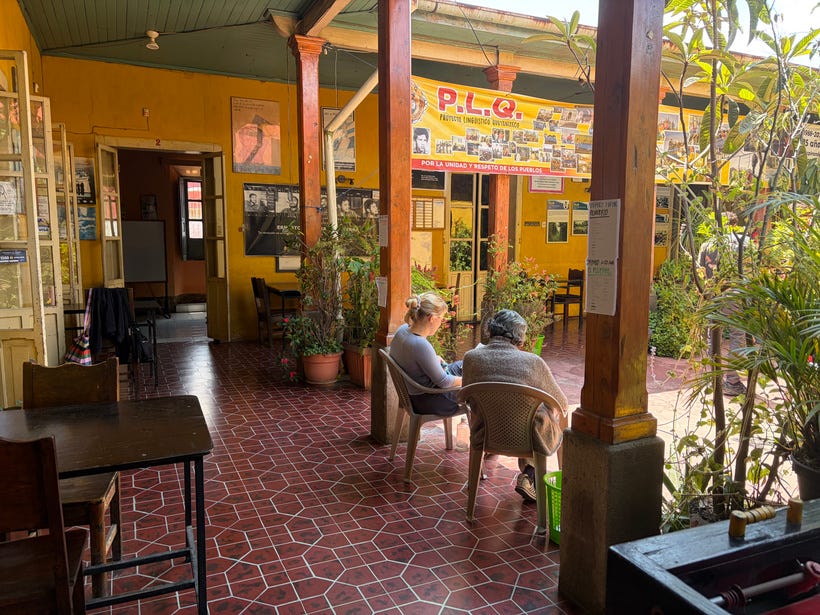
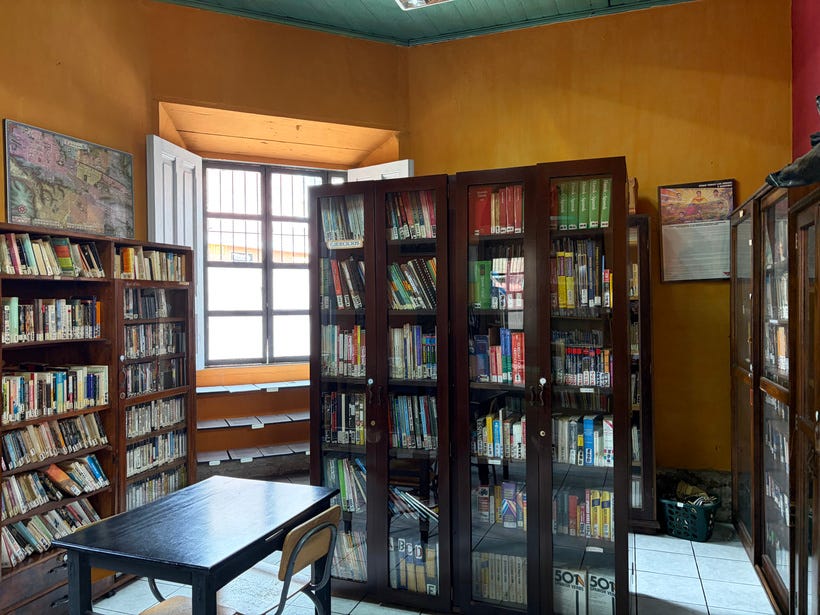
After the orientation + history lesson, we checked the white board in the courtyard to find our name next to our assigned teacher. I scanned the board till I found Tess — Irina. The desks were arranged around the perimeter of the courtyard, a small open garden exposed to the sky, a table with two chairs sat opposite each other. I got to know my corner seat view by the Biblioteca quite well. Red tiled floors, yellow walls, green plants in brown pots, posters of revolutionaries and humanitarian campaigns from around the world. Free Palestine, anti-Rios Montt, labor union coalitions, women’s march. My teacher Irina was extremely calm and patient. She wore a brown haired pixie cut with brown eyes behind brown glasses. We went over present tense first, which I had previously learned in high school but definitely needed a refresher on. A sense of youngness enveloped me. A feeling with such lack of words. Frustration and wonder, disconnection and connection oscillating as I stumbled to find any words at all. Humbling to say the least. Even still, we talked at length. Mostly me listening. Parsing what little Spanish I had into very short questions, remarks, and answers. We talked about Mayan culture and their incredible and extensive astrological observations. She told me about her life and her daughter, working two jobs, one at PLQ during the day and another at the university at night. We talked about healthcare, politics, and gender norms in our respective countries. By the end of the week, I felt a profound sense of connection with Irina and how special it is to simply sit down with someone and try to understand one another.
After a beautiful week at PLQ, we headed to the mountain school. We drove through tropical greenery, passing motorbikes, dogs, kids, and small towns as we wound our way to the school. We pulled into what felt like a little sanctuary. Dense trees, dotted with flowers, filled the property to its edges, small paths curving around the building, connected small structures, ranchitos, made of wood and palm fronds, where we would have our classes each day. Two colorful hammocks hung side by side on the low porch. One was occupied. A pair of and dropped a book to the lap, revealing a sweet looking boy with short brown hair. He stood up to greet us, rising much taller than I expected. Not a boy at all, although a few years younger than us. A very sincere sense of openness and kindness filled the air around him. We exchanged names and hellos as we retrieved our bags from the trunk of the car. “Tom,” he said, smiling shyly. We got to know Tom easily throughout the week as we found out quickly how much he enjoyed talking. He had just graduated from university in England and was spending some time traveling around, visiting friends, and enjoying some time before returning to the UK to decide what was next for him. It worked out nicely to have another person to round out our trio, Grace, Stella, and myself. And now Tom. We exchanged card games, our favorite nightly pastime accompanied by copious sleeves of oreos and a few bottles of Gallos, the country’s most popular beer. Our first night, the shared bathroom door got locked accidentally, the wooden rectangle that was screwed into the doorframe had fallen from its upright position over to the side into the lock position. After many failed attempts at sliding various objects up and down the frame, we decided to fashion an extra large pole consisting of three broomsticks taped together to flip the lock from the inside using the outside window. It was almost anticlimactic how quickly it worked, Tom standing taller than usual on a rickety table, our phone flashlights illuminating the small bathroom from the outside. It felt like camp. And set a fun tone for how we would interacted together. Later in the week, we created a scavenger hunt for the next students, which included various riddles we hid around the property; in the biblioteca, inside the battery compartment of the tv remote in kitchen area, behind a diagram of how to properly use a compost toilet in the bright blue baño outside, under one of the beams that supported the hammocks on the porch. I had told a friend we made at PLQ who would be studying at EM the week after us that I’d leave her a scavenger hunt so I felt motivated to keep my word.
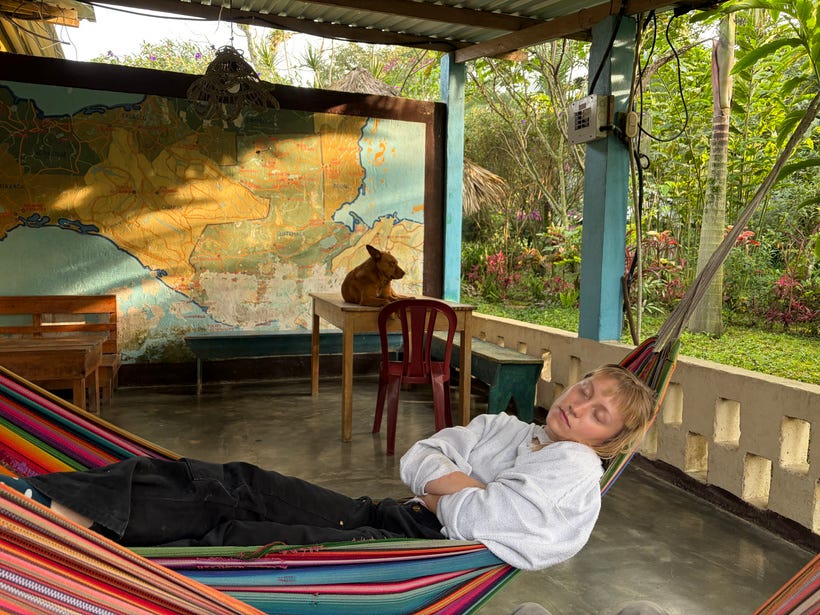
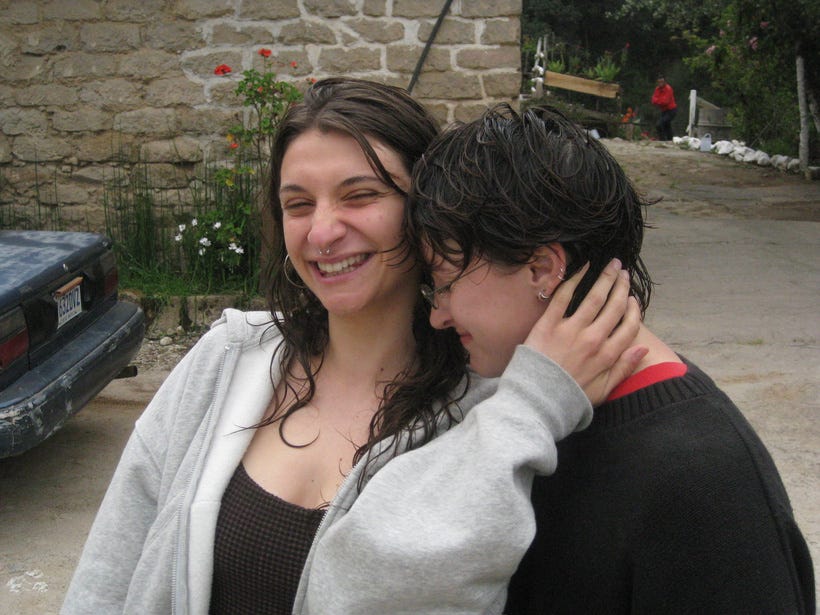
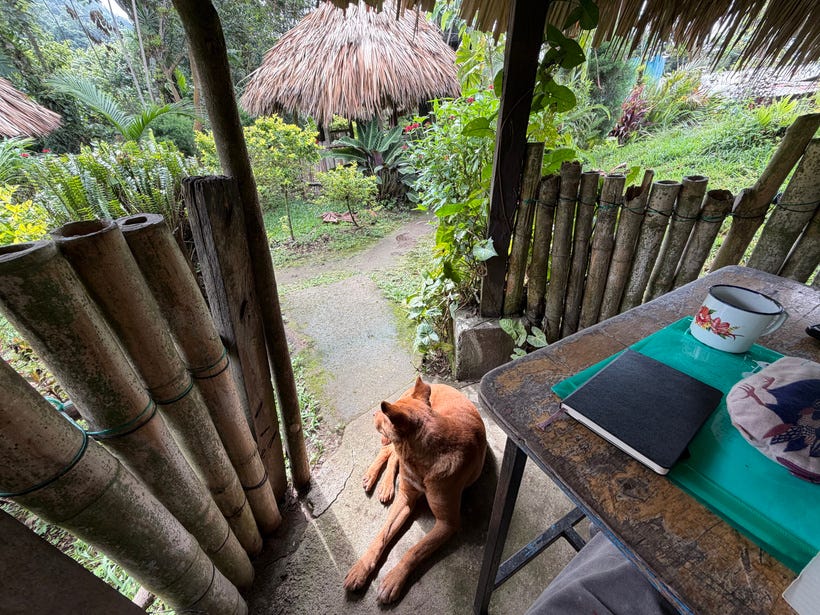
There were 7 students total: Birdie, Chris, Mishonne, Tom, Stella, Grace, Tess. Each room had a different collection of twin and bunk beds, all covered with heavy patterned fleece camping blankets. The rain came reliably every afternoon to patter or pound on the roof. Most of the time, we had no running water, so a big bucket of water sat beside the toilet for scooping into the tank to be flushed manually. I took one freezing cold shower on the second day and I had a hair washing session in the rain with Grace and Stella on the sixth day. I used baby wipes every night to wipe down the grime but mostly I felt surrendered to the experience we were all sharing. We had class every morning and an activity in the afternoon. We walked to our host families for breakfast at 7:30AM, lunch at 12:30PM, and dinner at 5:30PM. One of the best parts of the mountain school was Bebé, the school’s dog. A beautiful bronze pit mix, with a perpetual smile. My teacher, Rocael, told me he must really have bonded with us because he didn’t usually join the students for their meals, something we had gotten used to, despite being told to keep Bebé inside the school grounds. Every meal time Bebé came bounding out of some secret hole in the fence, happily and loyally joining us for our meals. All the student’s families lived on the same street about a 5 minute walk from the school. Bebé would start out following Tom to his meal, usually entering my family’s house towards the end of my meal to walk me home.
One of the main concerns we had to be aware of as visitors was food and water safety, as Guatemala doesn’t have a well developed water system, meaning the water is contaminated with bacteria from waste, rain, wear, etc. You brush your teeth with water from your water bottle and keep your mouth closed in the shower, both of which I was very careful to do. As far as eating at restaurants, you’re supposed to only drink filtered water and food cooked with it, and avoid any uncooked produce as it is more likely to have been contaminated. Again, motivated by my anxiety of getting sick, I was very careful to adhere to these rules. In general the fear of getting sick and not having control over my food prep, especially in my host family’s house, was a challenge during this trip. It also didn’t help that Tom had been very sick the week before and another student also got sick during our week at the mountain school.
My host mom’s name was Magda. Her family worked on a coffee finca nearby that experienced extreme mistreatment, the owners withholding pay for years. When the laborers unionized they were all fired and blacklisted from working anywhere nearby. Without sufficient finances they couldn’t relocate, forcing many of these families into extreme poverty. The community has since taken their neighborhood into their own hands, owning land communally, fixing up each other’s houses, building and maintaining a water and waste system, all with support and funds from EM. EM also provides financial support to these families through the host program for student’s meal times. Also offering a rotation of opportunities for some of the women in the town to come work at the school each week. Magda is one of the women in this rotation. Magda has 9 children. Her husband Jose works in Xela, commuting early in the morning about 1.5hrs to work as a day laborer in construction and heading home late each night. The house was a simple cement structure, pieces of metal layered over top as cover. A stove, one table, and one light atop a slab of earthen floor. The bedroom next to the kitchen had one large room with a row of 10 twin beds pushed together. The chickens and stray dogs came in and out freely. It was difficult to speak well with Magda. I was grateful after talking to the other students that my host mom asked questions and answered mine extensively than others were experiencing. I felt like we actually got to know each other over the week, though it required patience and a little bit of charades on both of our parts. Though it seemed I was having more conversation than the other students, it quickly became clear I was not eating similarly to my friends. My first breakfast with Magda was spaghetti with sliced carrots. Another breakfast, just a bowl of almond milk with a few oats floating about. One notable dinner Grace also had at her host mom’s house, was a bowl of cut up hot dogs (long ways) in tomato sauce. Stella was having pancakes and plantains, Tom was having chicken and cheese. I never got sick and I feel really grateful for the time I got to spend with Magda. It was definitely an exercise of relating, entering into someone else’s reality in a very visceral way, with my body, even if for only a few hours a day
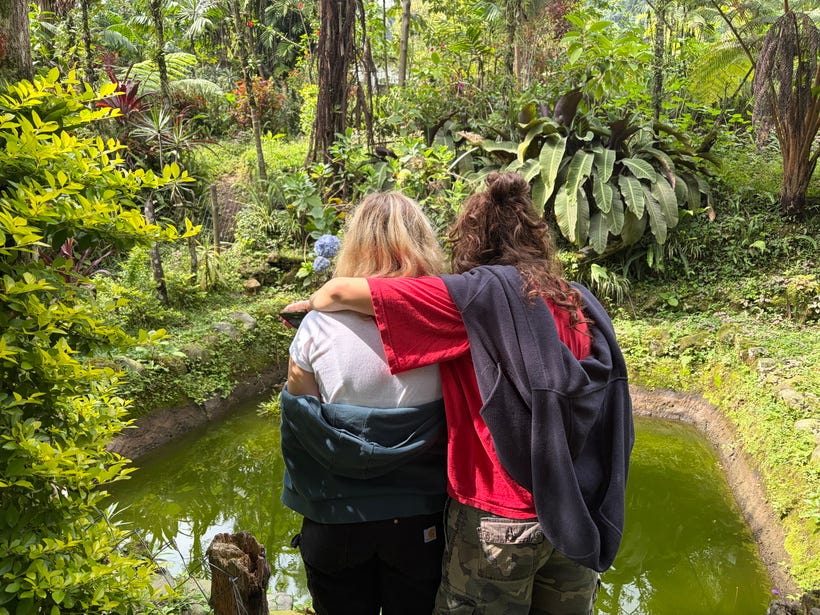
The most notable excursion from the mountain school was our trip to Santa Anita, the self-sustained coffee farm community of ex-guerillas and their families that we watched a documentary about (When the Mountains Tremble) the week prior. We walked many miles across sprawling land filled with a diverse array of plants and animals. Parting branches in our path, sweat dripping beneath our long sleeve shirts, sweet relief presented itself in the form of a beautiful waterfall to dunk our heads and hands in, salt sloughing off in the spray. This was one of my most fun memories in Guatemala. This day also held one of my worst. Our transportation for the journey was an old Toyota pick up truck. Truly the standard mode of transportation there. The majority of cars are pick up trucks, many times carrying people, produce, furniture, tools, you name it, in the back cab. The ride there was beautiful and exciting, to stand up into the wind and take in the view. On the way home however, the rain had started, as it did almost every afternoon. The cab was covered now in a blue tarp, our guides well versed in weather changes and solutions for them. Huddled under the tarp and the hoods of our rain jackets, we sat in the back, knees to chest, chatting, watching the world breeze behind us from the arched opening at the back of the cab. We suddenly felt a bump under the front, then back of the truck, a dog appearing out from under the wheels. Whipping its head back and forth towards its haunches, the back half of its body clearly broken as it hobbled and howled to the side of the road. The truck continued on. Grace reflected back to me my incongruous response. Smile frozen in shock. Sometimes the wires get crossed, we were just smiling before it happened. It’s hard to process something so immediate so outside of you. I buried my head in Stella’s shoulder, my stomach flipping, face sinking now into its appropriate position. We rode home silently. We got home as the rain finally let up. We greeted Bebé with relief and gratitude. Petting our beloved pup as much as we could before having to go inside where he wasn’t allowed. The next night, our last night, he somehow snuck his way inside, as if sensing our impending departure. We turned a blind eye to let him sleep under the kitchen table while we played cards, savoring each others company for our last night together.
༄
At the end of the week, the school hosts a customary graduation where each student has the opportunity to share something in Spanish with their teachers and classmates. Stella, Grace, and I belabored what we should do, thinking we’d learn a Spanish song to perform together but eventually we each decided to share some words separately. Here is mine in both Spanish and English:
Me acuesto con el sonido de la lluvia
Yo tengo sueños de verde
para la gente de Guatemala
Veo a Irina tomar una taza de té en la mañana
Veo a Rocael jugar tranquilamente con su gato de ojos verdes
Veo a Magda descansar en el campo con su familia
Veo a Jorge y Teresa disfrutar el jardín
Me despierto con el sonido de los pájaros
Yo solamente pasado quince días debajo de este cielo
El cielo llora
El cielo sonríe
El pájaro grita
El pájaro está silencio
Como la lluvia y los pájaros
Como la dia y la noche
Lloro y sonrío
Grito y estoy silencio
Me voy, pero volveré
༄
I go to bed with the sound of rain
I have dreams of green for the people of Guatemala
I see Irina drinking a cup of tea in the morning
I see Rocael playing peacefully with his green-eyed cat
I see Magda resting in the countryside with her family
I see Jorge and Teresa enjoying the garden
I wake up to the sound of birds
I’ve only spent fifteen days under this sky
The sky cries
The sky smiles
The bird screams
The bird is silent
Like the rain and the birds
Like day and night
I cry and I smile
I scream and I am silent
I leave but I will return
Okay finally. We are at the end of this novel! It has taken me an incredibly long time to write all of this but I’m glad I have transcribed the experience for posterity and for sharing with you all. Thanks to you, if you have read any of this. I hope you got a clearer picture of my time in Guatemala, what I saw, learned, who I met, how I felt, etc. Honduras next, sending love! Talk soon.
༄ Tess